
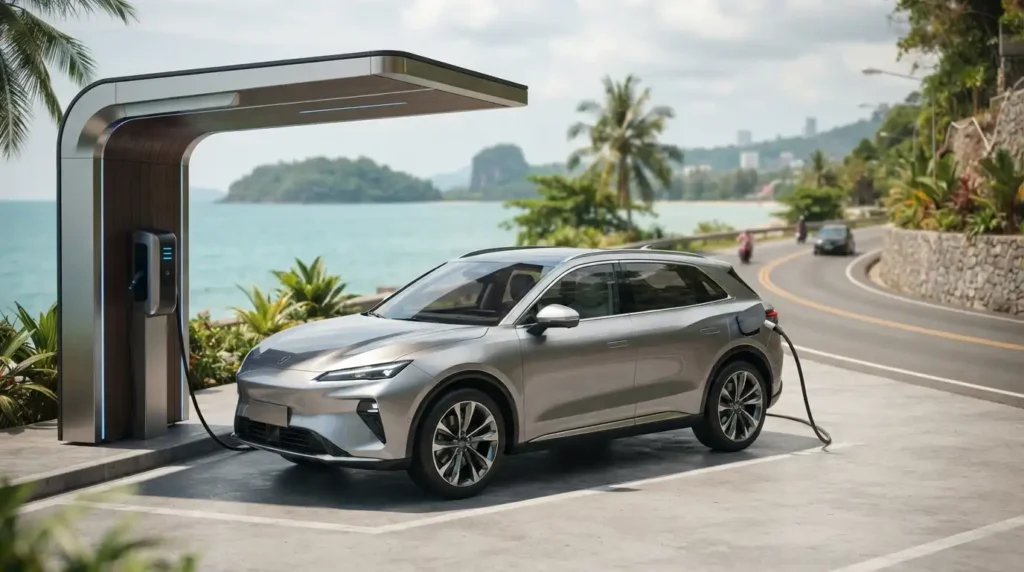
For over half a century, the Southeast Asian automotive landscape was defined by an undisputed dominance: Japanese automakers. Across the ten member states of the Association of Southeast Asian Nations (ASEAN), brands like Toyota, Honda, Isuzu, and Mitsubishi commanded upwards of 80 to 90 percent of regional vehicle sales. From the ubiquitous pickup trucks on Thai highways to multi-purpose vehicles (MPVs) navigating Jakarta’s urban core, Japanese internal combustion engine (ICE) vehicles established an ironclad monopoly on regional mobility.
However, an unprecedented industrial transformation is sweeping across the region. Driven by aggressive global expansion, vertical integration, and rapid technological advancement, Chinese electric vehicle (EV) manufacturers are spearheading an electric surge across Southeast Asia. Led by heavyweights such as BYD, Geely, Great Wall Motor (GWM), and SAIC’s MG, these brands are shifting the Asia auto market from traditional gas-powered cars toward affordable, feature-packed battery electric vehicles.
Policy Tailwinds and the ASEAN EV Boom
The rapid rise of Chinese EVs in Southeast Asia is not an accident of timing; it is the result of strategic alignment between Chinese corporate ambition and forward-looking government policies across major ASEAN economies.
Thailand, long dubbed the “Detroit of Asia” for its robust automotive supply chain, introduced its ambitious Vision Zero and EV incentive packages (such as the EV3.0 and EV3.5 schemes). These policies slashed import duties and excise taxes for foreign EV manufacturers in exchange for firm commitments to establish localized assembly plants within the kingdom. Similarly, Indonesia leveraged its massive domestic nickel reserves—a crucial raw material for EV battery production—to compel international automakers to invest directly in local battery gigafactories and end-to-end supply chains.
These policy initiatives drastically lowered the barrier to entry for electric vehicles, creating a prime environment for agile Chinese manufacturers ready to scale production quickly.
Key Chinese Players Redefining the Region
Rather than treating Southeast Asia merely as an export destination, Chinese automotive giants are making long-term capital investments, building regional manufacturing hubs, establishing dealer networks, and adapting products to local driving conditions:
1. BYD (Build Your Dreams)
BYD has emerged as the spearhead of China’s overseas EV expansion. Capitalizing on its vertically integrated battery technology (the Blade Battery), BYD launched popular mass-market models like the Atto 3 crossover and Dolphin hatchback across Thailand, Malaysia, Indonesia, and the Philippines. BYD’s dedicated assembly plant in Rayong, Thailand, alongside multi-million-dollar investment plans in Indonesia, underscores its commitment to establishing localized production bases across ASEAN.
2. Geely Auto Group
Geely has taken a multi-pronged approach to conquering Southeast Asia. Beyond introducing its premium electric sub-brands like Zeekr and Smart, Geely expanded its foothold by taking a controlling stake in Malaysia’s national carmaker, Proton. Through this strategic alliance, Geely is leveraging Proton’s established manufacturing plants and dealer infrastructure to localize electric powertrain technology for regional consumption.
3. Great Wall Motor (GWM) & SAIC (MG)
GWM was among the earliest Chinese entrants to establish a firm footprint in Thailand with its Ora Good Cat EV, captivating urban commuters with retro-futuristic styling and high-tech cabin features. Meanwhile, SAIC Motor’s MG brand has maintained strong sales momentum by pricing accessible electric station wagons and compact crossovers directly against traditional Japanese gas-powered sedans.
How Chinese EV Makers Are Outpacing Legacy Competitors
The secret behind China’s rapid market capture lies in three competitive advantages: pricing power, software integration, and aggressive speed-to-market.
- Price-Point Parity: By producing batteries in-house and benefiting from massive domestic production scale, Chinese OEMs offer fully electric vehicles at price points previously reserved for entry-level ICE compacts.
- Tech-First Interior Specs: Southeast Asian consumers—particularly younger demographics—are drawn to advanced digital cockpits, over-the-air (OTA) software updates, voice-controlled assistants, and driver-assist suites that legacy automakers traditionally reserve for top-tier luxury trims.
- Agile Product Cycles: While traditional automotive product development cycles often span five to seven years, Chinese EV brands iterate new models and platform updates in as little as 18 to 24 months, allowing them to react rapidly to shifting market trends.
The Strategic Response from Japanese Auto Giants
The rapid erosion of market share has forced legacy Japanese manufacturers to rethink their regional defense strategies. Historically cautious regarding full battery electric transition, brands like Toyota and Honda are accelerating their electrification roadmaps to protect their core markets.
Toyota has expanded its hybrid-electric vehicle (HEV) offerings across the region while committing capital toward local EV assembly lines in Thailand and Indonesia. Similarly, Isuzu and Mitsubishi are developing electric and hybrid variants of their popular 1-ton pickup trucks and commercial vans to defend their dominant positions in commercial fleet sectors.
However, as charging infrastructure expands across major metropolitan centers from Bangkok to Kuala Lumpur, the transition toward pure BEVs continues to gain momentum over traditional internal combustion options.
The Future Outlook for the Asian Automotive Industry
The transformation taking place across Southeast Asia extends far beyond individual car sales; it represents a fundamental re-engineering of the regional industrial supply chain. As Chinese automakers build localized component factories, partner with regional energy firms for charging networks, and create high-tech engineering jobs, ASEAN is rapidly morphing into a global hub for electric vehicle manufacturing and export.
For car buyers across Asia, this competition yields clear benefits: lower purchase prices, broader model availability, faster technology deployment, and an accelerated transition toward cleaner, sustainable urban transportation. The electric surge is no longer on the horizon—it is actively reshaping the roads of Southeast Asia today.