
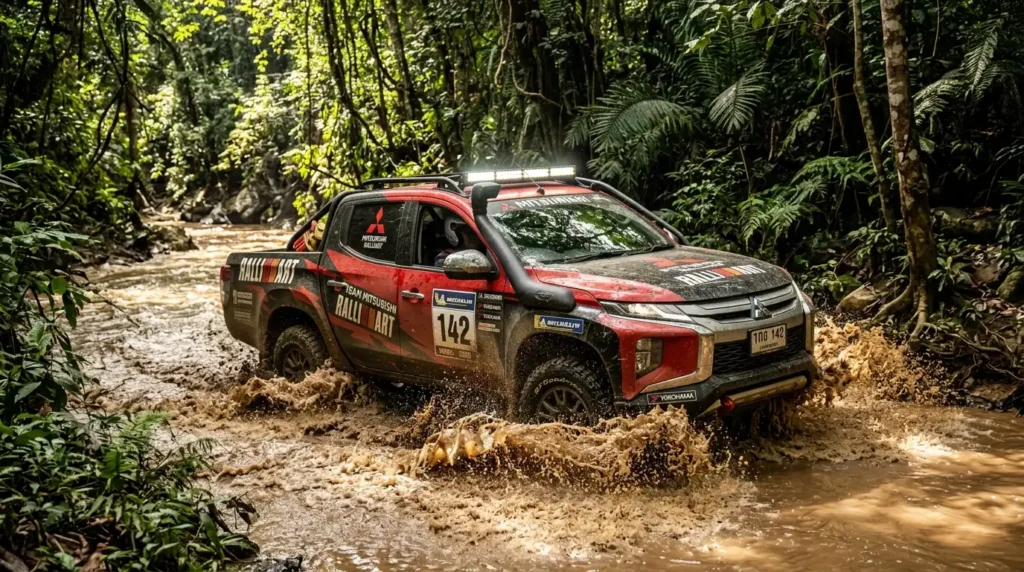
When it comes to proving off-road capability, controlled laboratory tests and smoothed-out proving grounds can only reveal so much. True mechanical validation requires punishment under extreme real-world conditions. Spanning over 2,100 kilometers across demanding tropical terrain—ranging from mud-filled eucalyptus plantations and swollen river crossings to rutted mountain passes—the Asia Cross Country Rally (AXCR) is widely recognized as Southeast Asia’s ultimate off-road proving ground. At the center of this grueling arena stands Team Mitsubishi Ralliart, which recently secured a historic back-to-back overall victory at AXCR 2026 with a heavily modified, production-based Triton pickup truck platform.
Enforcing strict FIA Group T1 regulations, AXCR requires competing vehicles to maintain their production steel body shells, main chassis frame rails, and base engine block architecture. Driven by Japanese rally veteran Katsuhiko Taguchi and co-driver Takahiro Yasui to overall victory, the race-prepared Triton demonstrated that production-based pickups can dominate extreme endurance events through targeted chassis reinforcement, precise suspension tuning, and advanced thermal management.
1. Chassis Architecture: Reinforcing the Ladder Frame for Extreme Shock Loads
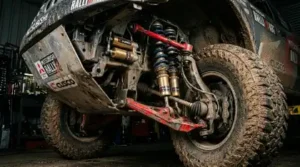
The foundation of the AXCR-spec Triton rests on its high-rigidity ladder frame chassis. Navigating washboard plantation tracks and hidden rock beds at high speeds subjects the chassis frame rails to severe torsional twist and vertical shock loads. Rather than replacing factory elements with a full custom tube-frame chassis, Ralliart engineers focused on enhancing structural integrity while staying within Group T1 weight allowances.
Detailed structural modifications on the competition platform include:
- Integrated Chromoly Roll Cage: An FIA-homologated roll cage welded directly to key structural pick-up points on the ladder frame, significantly boosting overall torsional rigidity.
- Full-Length Underbody Protection: Heavy-duty aluminum skid plates protecting the front steering linkages, engine sump, transmission, and transfer case against severe rock strikes.
- Carbon-Composite Bodywork: Carbon-fiber hood, front and rear door panels, and cargo bed sides fitted to offset the added weight of mandatory safety gear and dual full-sized spare wheels.
By stiffening the underlying structure, engineers created a rock-solid platform that allows the suspension to react instantly to sudden surface transitions without flexing the vehicle’s body shell.
2. Powertrain Optimization and Thermal Management
Powering the competition truck is Mitsubishi’s production-based 2.4-liter clean diesel engine equipped with a two-stage VG turbocharger system, delivering over 214 horsepower and more than 500 Nm of torque. While raw output is essential for powering through deep mud ruts, maintaining engine reliability in 40°C tropical heat and high humidity presented the real engineering hurdle.
According to technical documentation released on the official Mitsubishi Motors newsroom, engineers upgraded critical engine management and cooling systems to withstand continuous high-load stages:
| Component | Ralliart AXCR Competition Spec | Rally Endurance Advantage |
|---|---|---|
| Turbocharger & ECU | VG Turbocharger with custom ECU mapping | Delivers broader low-rpm torque for instant mud-extraction response. |
| Cooling Package | High-capacity radiator & dual Moty’s fluid coolers | Prevents thermal derating during long low-speed, high-stress hill climbs. |
| Intake System | High-mount A-pillar snorkel with pre-cleaner filter | Prevents water ingestion during deep river crossings and dust contamination. |
| Drivetrain Locks | Front and rear Cusco Limited-Slip Differentials (LSD) | Ensures maximum traction across low-grip clay and split-friction surfaces. |
Power is delivered through a high-torque sequential transmission paired with an Ogura reinforced clutch and Moty’s synthetic gear lubricants, giving drivers precise control over power delivery across unpredictable terrain.
3. Advanced Suspension Tuning: Cusco Twin Dampers and Widen Track
Cross-country rally victories are determined far more by suspension performance than by straight-line speed. If a vehicle cannot maintain tire contact over deep ruts or absorb sudden compression hits without bottoming out, the driver is forced to reduce speed.
For AXCR 2026, Ralliart engineers refined the Triton’s suspension geometry by pairing the front independent double wishbone and rear rigid setup with Cusco adjustable twin dampers. Additional dampening details can be reviewed on the ZigWheels technical analysis portal:
- Dual Remote-Reservoir Shock Absorbers: Adjustable high-speed and low-speed compression/rebound settings allow mechanics to tailor damping characteristics to daily stage conditions.
- Extended Track Width: Widened track dimensions combined with forged suspension arms accommodate longer suspension travel without binding CV joints.
- Specialized Off-Road Wheels & Tires: Lightweight alloy wheels paired with deep-tread competition tires slice through soft mud layers to reach firm underlying soil.
This suspension calibration allowed driver Katsuhiko Taguchi to maintain precise driving lines over rough unpaved tracks, minimizing tire punctures and giving the team a crucial edge on high-speed plantation stages.
4. Bivouac Logistics and the Mitsubishi Delica Support Fleet
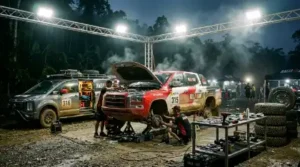
Endurance rallying is as much a logistical challenge as a test of driving skill. The AXCR route moves to new locations each day, requiring service bivouacs to dismantle, travel across regional highways, and set up mobile repair shops within hours.
To support the three competition Tritons, Team Mitsubishi Ralliart relies on a fleet of customized Mitsubishi Delica D:5 support vehicles. Utilizing Super All-Wheel Control (S-AWC), heavy-duty roof racks, and raised ground clearance, these support vans transport spare gearboxes, spare tire sets, welding units, and telemetry hardware deep into remote assistance points along the route.
This mobile support network allows mechanics to perform rapid service routines during short mid-day service windows, keeping all three competition entries in race-ready condition throughout the week-long event.
5. Telemetry Transfer: From AXCR to Production Showrooms
For Mitsubishi Motors, participation in cross-country rallying serves as a real-world testing ground for production vehicle development. Data gathered from ECU telemetry, strain gauges on chassis mounts, and thermal sensors on differential housings feed directly into the brand’s production vehicle engineering teams.
Key areas of technology transfer include:
- Super Select 4WD-II System Refinement: Real-world wheel-slip algorithms gathered from mud and rock stages help fine-tune electronic traction control modes on consumer models.
- Chassis & Body Sealing Enhancements: Water-wading tests through tropical river crossings inform improvements in electrical harness sealing and corrosion resistance for production trucks sold globally.
- Structural Durability Standards: Stress data logged during high-speed impact landings help refine production frame welding processes and suspension component durability.
A Modern Legacy of Off-Road Dominance
Team Mitsubishi Ralliart’s victory at the 2026 Asia Cross Country Rally reinforces the brand’s legacy of off-road engineering excellence. By demonstrating that a production-based pickup truck can withstand over 2,100 kilometers of severe tropical terrain, Mitsubishi proves that structural durability, advanced four-wheel-drive technology, and proper thermal engineering remain the core pillars of modern truck performance.
As off-road competitions push vehicles to greater limits, the engineering lessons forged in the jungles and river crossings of Southeast Asia will continue to shape safer, tougher, and more capable vehicles for drivers worldwide.