
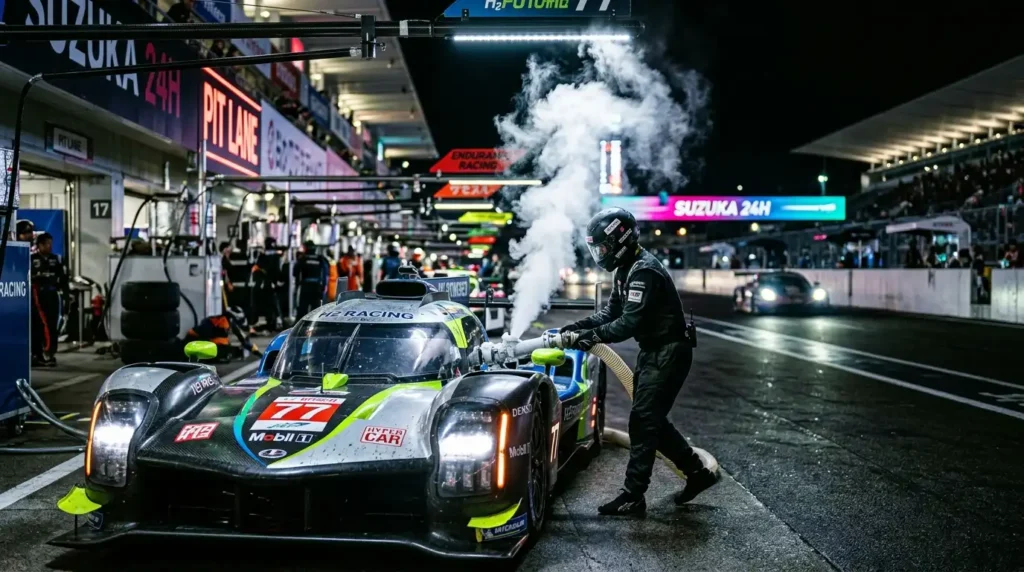
In the global race toward decarbonization, the automotive industry has largely gravitated toward battery-electric vehicles (BEVs). However, motorsport demands sustained high performance, light weight, and rapid refueling—areas where heavy lithium-ion battery packs face severe physical constraints over long distances. Across Asia, a parallel revolution is unfolding: utilizing the extreme crucible of endurance racing to prove that internal combustion engines (ICE) can survive and thrive in a zero-emission era by burning hydrogen fuel.
Led by Japan’s iconic Super Taikyu Series and driven forward by visionaries at Toyota, regional circuits across Asia are transforming into real-world laboratories. By testing gaseous and liquid hydrogen combustion technology under continuous 24-hour race conditions, Asian motorsport is preserving the visceral sound and emotional thrill of racing while pioneering sustainable energy solutions for future mobility.
Super Taikyu and the ST-Q Class: The Innovation Playground
Asia’s hydrogen motorsport surge took root within the ENEOS Super Taikyu Series, a renowned pro-am endurance championship in Japan. Unlike conventional racing series bound by rigid technical homologations, Super Taikyu features the progressive ST-Q class—a dedicated category created specifically for manufacturer-backed development prototypes running on alternative fuels.
In 2021, Toyota Gazoo ROOKIE Racing made history by entering a modified GR Corolla powered by a hydrogen-burning 1.6-liter turbocharged inline-3 engine into the Fuji 24 Hours. Burning pure hydrogen instead of gasoline produces virtually zero carbon dioxide ($CO_2$) emissions from the tailpipe, retaining traditional engine acoustics while eliminating harmful greenhouse gases.
The ST-Q platform allows engineers to refine technologies under real-time racing pressures, yielding rapid engineering breakthroughs:
- Transition from Gas to Liquid Hydrogen: Early iterations relied on compressed gaseous hydrogen stored at high pressure ($70\text{ MPa}$). By shifting to cryogenic liquid hydrogen stored at $-253^\circ\text{C}$, engineers doubled the fuel’s energy density by volume, significantly extending stint lengths between pit stops.
- Superconducting Pump Technology: Recent developments include race-testing world-first superconducting motors for liquid hydrogen fuel pumps, utilizing the cryogenic environment inside the tank to boost pump efficiency, lower vehicle weight, and maximize output.
- Direct Automatic Transmission Integration: Pairing hydrogen combustion engines with high-speed automated transmissions (such as Toyota’s Direct Automatic Transmission) broadens the appeal and scalability of alternative-fuel technology beyond pure manual gearboxes.
Cryogenic Logistics & Trackside Refueling Infrastructure
Bringing hydrogen to a race track involves far more than simply tuning an engine; it requires building a mobile, ultra-safe fuel infrastructure capable of operating under high-intensity pit stop conditions. Handling liquid hydrogen requires specialized safety protocols and cryogenic engineering discipline:
1. Rapid Pit Stop Refueling
Early gaseous hydrogen refuels required lengthy pressure equalization cycles. Shifting to liquid hydrogen and developing high-flow, dual-valve filling couplers has drastically reduced pit stop times. Refueling a liquid hydrogen race car now approaches the speed of traditional gasoline stops, making hydrogen highly competitive for multi-hour endurance events.
2. Mobile Hydrogen Hubs and Paddock Safety
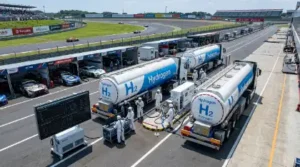
Race tracks like Fuji Speedway rely on mobile trackside hydrogen supply stations. These transportable hubs store liquid hydrogen, manage pressure venting, and feature automated optical and thermal sensors to detect leaks instantantly. Developing portable refueling hardware during race weekends builds the operational blueprint for future commercial hydrogen corridors.
3. Multi-Pathway Supply Chains
The hydrogen supplied at Asian circuits is increasingly sourced from renewable local projects—including green hydrogen produced using solar power in Fukushima or biomass-derived hydrogen sourced in Southeast Asia—ensuring a clean energy lifecycle from production to the pit lane.
Hydrogen Combustion vs. Pure Electric in Endurance Racing
While battery-electric powertrains excel in short-distance sprint formats (such as Formula E), endurance racing highlights the inherent advantages of hydrogen combustion for sustained long-distance competition:
| Performance Metric | Hydrogen Combustion (H2 ICE) | Battery-Electric (BEV) |
|---|---|---|
| Refueling Speed | Rapid fuel pump connection (minutes) | Requires long fast-charging stops or complex battery swaps |
| Vehicle Weight | Lighter fuel tank weight; vehicle gets lighter as fuel burns | Heavy battery pack weight remains constant throughout the race |
| Thermal Management | Engine cooling manageable via upgraded radiators | Severe thermal throttling under continuous max power drawdown |
| Fan Engagement | Preserves traditional mechanical engine roar and exhaust sound | Near-silent operation with minimal acoustic feedback |
Expanding the Footprint Across Southeast Asian Circuits
The momentum generated in Japan is rapidly spreading across regional motorsport hubs in Southeast Asia. Recognizing that different global regions require diverse energy solutions, Asian racing organizations are collaborating to test hydrogen and carbon-neutral synthetic fuels under tropical heat and humidity.
Events like the 10-hour and 25-hour endurance races held at the Chang International Circuit in Buriram, Thailand, have become vital testing grounds outside Japan. Running hydrogen-powered prototypes alongside carbon-neutral synthetic fuel entries and hybrid vehicles in Southeast Asia proves that zero-emission technologies can withstand punishing tropical ambient temperatures while expanding clean energy options for the entire Asian automotive market.
The Road Ahead for Clean Motorsport
Asia’s hydrogen motorsport surge proves that the path toward carbon neutrality does not require abandoning the rich heritage, sound, and mechanical excitement of internal combustion. By using endurance racing as a high-speed proving ground, Toyota, Super Taikyu organizers, and regional Asian circuits are accelerating liquid hydrogen combustion, cryogenic pump engineering, and clean supply chains. Through intense competition on the track, hydrogen endurance racing is securing a thrilling, carbon-neutral future for motorsport worldwide.