
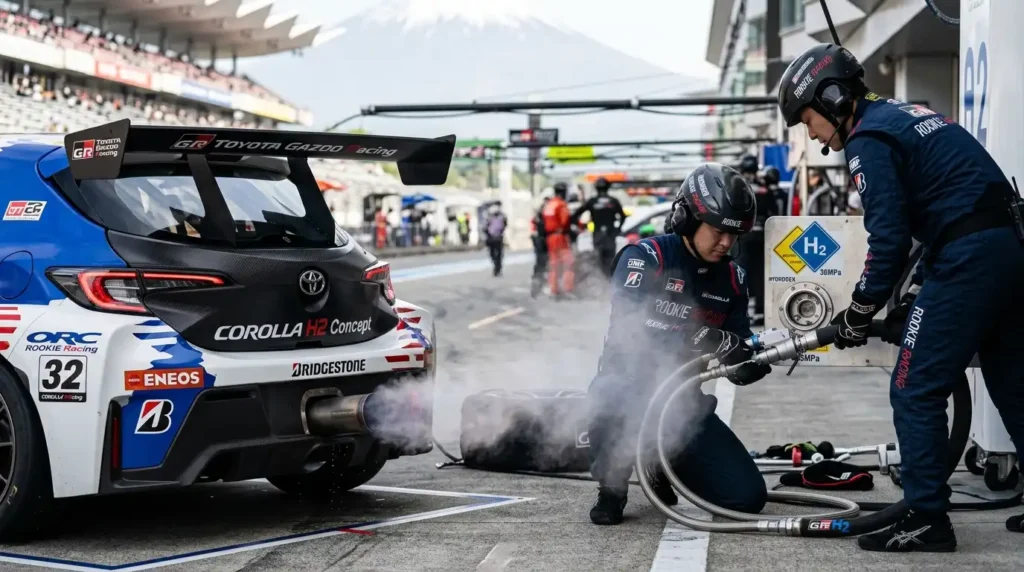
The green transition in motorsports has long felt like a choice between two compromises: accepting the massive battery weight of electric vehicles or clinging to sustainable synthetic fuels that still rely on traditional combustion architectures. However, at the 2026 edition of the NAPAC Fuji 24 Hours, Toyota shattered this binary paradigm. Entering their heavily revised #32 ORC ROOKIE GR Corolla H2 Concept, the Japanese automotive giant didn’t just showcase an evolutionary step in alternative fuels—they debuted a world-first engineering breakthrough: a superconducting liquid hydrogen pump operating under extreme racing conditions.
By leveraging the physics of superconductivity within the freezing confines of a liquid hydrogen fuel system, Toyota is solving the single biggest Achilles’ heel of hydrogen racing—stint range and refueling efficiency. This isn’t merely a laboratory experiment wrapped in racing decals. It is a grueling, 24-hour endurance test designed to prove that hydrogen can match the continuous, high-intensity pace of traditional internal combustion engines.
The Superconductivity Breakthrough Explained
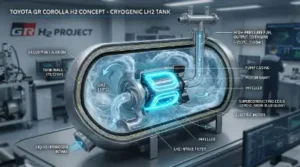 To understand the magnitude of this advancement, one must first look at the punishing physics of liquid hydrogen. For hydrogen to remain in a liquid state, it must be cryogenically cooled and stored at a staggering -253°C (-423°F). In previous iterations of the GR Corolla H2, pushing this ultra-cold liquid fuel from the storage tanks to the engine’s direct-injection system required a heavy, mechanically complex pump located outside the fuel cell structure. These external pumps suffered from friction, thermal loss, and power parasitic drain.
Toyota’s breakthrough for the 2026 season flips this engineering problem on its head by utilizing the extreme cold to its advantage. Superconductivity is a phenomenon where certain materials exhibit exactly zero electrical resistance when cooled below a characteristic critical temperature. By wrapping the fuel pump’s electric motor in superconducting wires and submerging the entire unit directly inside the liquid hydrogen tank, Toyota eliminated electrical resistance entirely.
Because there is zero resistance, the motor generates practically no internal heat and operates with near-perfect electrical efficiency. This allows the pump to generate significantly higher injection pressures while drawing a fraction of the power required by a traditional mechanical or external electric pump. It turns the punishing sub-zero environment of the fuel tank into the ultimate performance enabler.
Solving the Packaging and Weight Dilemma
In endurance racing, space and weight distribution dictate lap times. The implementation of the internal superconducting pump has yielded massive aerodynamic and packaging dividends for the GR Corolla H2. By removing the bulky external pump apparatus, engineers managed to expand the internal volume of the fuel tanks without altering the car’s exterior footprint.
The results speak for themselves in the pit lane:
- Increased Fuel Capacity: Total liquid hydrogen storage volume increased by 1.3x, jumping from 220 liters in previous configurations to a massive 300 liters.
- Extended Stint Lengths: This capacity boost directly addresses hydrogen’s historic range anxiety, allowing the Corolla to stay out on the Fuji circuit for significantly longer stints between stops.
- Lower Center of Gravity: Moving the heavy pump mechanisms from an elevated position in the chassis to the low-slung, center-mounted floor tanks significantly improved the vehicle’s polar moment of inertia, translating to crisper corner entry and better tire preservation over long runs.
The Direct Automatic Transmission (DAT) Integration
The superconducting pump isn’t the only technical marvel under the skin of the 2026 prototype. For this 24-hour marathon, Toyota has paired the hydrogen combustion engine with their newly optimized Direct Automatic Transmission (DAT). Historically, hydrogen race cars utilized manual gearboxes to give drivers precise control over the engine’s unique, narrow torque band.
The inclusion of the DAT marks a massive shift toward commercial viability. The transmission uses specialized software algorithms tuned to predict driver intent based on brake pressure, throttle position, and steering angle. By executing lightning-fast, seamless gear changes, the DAT ensures the hydrogen engine stays locked in its absolute sweet spot of thermal efficiency. It removes the cognitive load from the driver during a grueling 24-hour stint, proving that high-performance hydrogen powertrains can be accessible, smooth, and devastatingly consistent over a full day of racing.
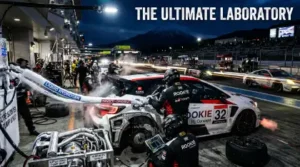
Why the Fuji 24 Hours is the Ultimate Laboratory
 Many industry critics question why Toyota continues to pour millions into hydrogen combustion instead of focusing purely on battery electric vehicles (BEVs) or hydrogen fuel cells. The answer lies in the harsh reality of the Asian automotive market and the unique demands of heavy-duty performance. Fuel cells, which convert hydrogen into electricity via a chemical reaction, are highly efficient but lack the raw response, emotional sound, and thermal ceiling required for GT racing. Combustion engines burning hydrogen retain the soulful roar of racing while emitting nothing but pure water vapor.
Furthermore, testing this technology at the Fuji 24 Hours forces rapid innovation cycles. A single 24-hour race compresses years of typical consumer driving data into a single weekend. The relentless vibrations of the rumble strips, the extreme G-forces of Fuji’s sweeping corners, and the thermal stress of continuous 6,000 RPM operation will expose any flaw in the superconducting pump’s insulation or electrical delivery.
The Roadmap to Commercial Production
What starts on the high-speed straightaways of Fuji Speedway invariably trickles down to the consumer market. The engineering insights gained from stabilizing a superconducting motor at -253°C under racing loads will directly impact the development of next-generation heavy transport, commercial shipping, and future high-performance road cars.
If Toyota can prove that superconducting components can survive a 24-hour endurance race, it unlocks the potential for ultra-efficient, long-range hydrogen infrastructure worldwide. It positions liquid hydrogen not as a distant, futuristic concept, but as a tangible, high-octane reality for the Asian motorsport landscape and beyond.